.png)

Inside the Rabbit Hole: The Secret Language and Jargon of Fountain Pens - A Beginners Guide to Fountain Pen Terminology
- 2 days ago
- 6 min read
Have you ever found yourself admiring a beautifully written note, perhaps even dipping your toe into the elegant world of fountain pens, only to be met with a barrage of terms that sound like they belong in a Victorian engineering manual or a secret society meeting? You're not alone! The fountain pen community, affectionately known as FP Geeks, has a rich, sometimes bewildering, lexicon all its own.
Forget "nib creep"—that harmless little shimmer of ink on your nib. That's just the tip of the iceberg! For the uninitiated, navigating conversations about "baby's bottom", "railroading", or the elusive "sweet spot" can feel like trying to decipher a foreign language. But fear not, aspiring aficionado! We're here to demystify the most common—and delightfully obscure—jargon and fountain pen terminology, turning you into a seasoned connoisseur in no time.
The Anatomy of a Pen (and its Peculiarities)
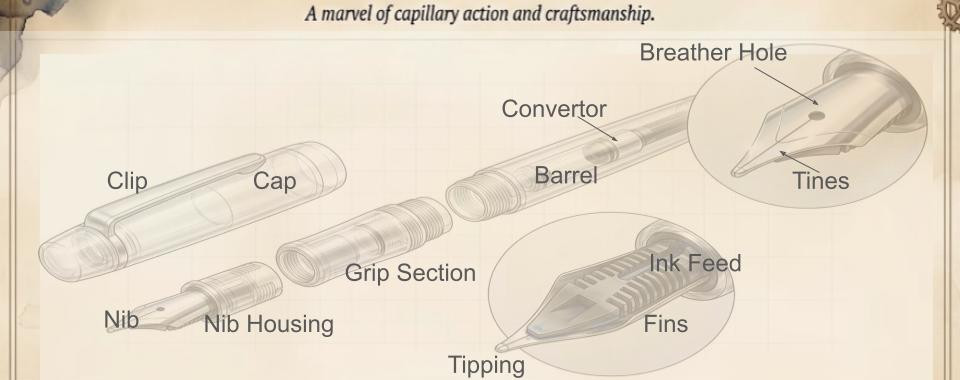
Let's start with the star of the show: the pen itself. A fountain pen isn't just a pen; it's a marvel of capillary action and craftsmanship. Its heart is the nib—the metal tip that touches the paper. Nibs come in various materials, from common steel to luxurious gold (often denoted by its karat, like 14k or 18k). The very tip of the nib, called the tipping or tipping material, is usually made of a hard-wearing material like iridium, which is polished to create a smooth writing surface. While we still call it "Iridium," almost no modern pens actually use the element Iridium anymore (it's too rare/expensive). Most modern tipping is a complex alloy of tungsten, osmium, and ruthenium. But if you call it tipping, or tipping material, everyone will know what you mean!
The nib connects to the feed, a crucial component that channels ink from the reservoir (the ink-holding part of the pen, like a converter or cartridge, or simply the barrel if it's an eyedropper pen) down to the nib through tiny channels called fins.
But sometimes, things go awry, leading to terms that describe less-than-ideal writing experiences:
Railroading: This visually striking issue occurs with flexible nibs when you press too hard, causing the ink flow to split and create two parallel lines, like miniature train tracks.
Baby's Bottom: Imagine the rounded backside of a baby—that's what the tipping of a nib looks like when it's over-polished, leading to annoying hard starts (the pen won't write immediately). It's a prime candidate for a visit to a nibmeister (a specialist who grinds and tunes nibs).
Hard Start: The frustrating moment you put pen to paper and... nothing. Unlike a skip in the middle of a sentence, a hard start happens right at the beginning of your writing session, often because the ink has dried slightly in the nib or due to that pesky baby's bottom we mentioned!
Burping: Primarily an eyedropper pen phenomenon. As the warmth of your hand heats the air in the barrel, it expands and forces a large, unwanted blob of ink out of the nib—often onto your pristine paper!
Scratchy: A pen feels "scratchy" when its nib isn't perfectly smooth on the paper, often due to misaligned tines (the two halves of the nib that meet at the tipping).
Nib Creep: That harmless, often colorful shimmer of ink that "creeps" out of the slit and onto the top surface of your nib. Some find it messy; others find it a beautiful sign of a pen that's ready to work! Many times this can be caused by the specific ink you are and the inks properties.
Springy vs. Flexy: A springy nib offers a slight bounce or cushion as you write, while a flexy (or flexible) nib allows the tines to spread significantly with pressure, creating dramatic line variation.
The Stub Nib: The "easy mode" for elegant writing! A stub nib is ground flat on the end, naturally creating thick vertical lines and thin horizontal ones without you having to change your writing pressure at all. This is different from Fude nibs, which have an upturned tip to vary line width based on the angle you hold the pen.

The Feel of the Write: Tactile Sensations and Flow
Beyond merely putting ink on paper, FP Geeks obsess over how it feels.
Feedback: This isn't a flaw; it's a characteristic! It describes the tactile sensation of the nib gliding (or not so much gliding) across the paper. Some prefer a "glassy smooth" feel, while others crave pencil-like feedback, a slightly textured sensation (a hallmark of brands like Sailor).
Tooth: A more pronounced version of feedback, a "toothy" nib almost feels like it's lightly gripping the paper fibers.
Dry vs. Wet: This refers to the ink flow. A "wet" pen (sometimes called a "firehose") lays down a generous amount of ink, making colors appear vibrant but prone to bleedthrough on cheaper paper. A "dry" pen, conversely, uses less ink, which is great for controlling feathering (when ink spreads erratically into paper fibers) but can make some inks look dull.
Sweet Spot: The specific, often very narrow, angle at which a particular nib writes its smoothest and best. Find it, and your writing experience transforms!
Posting: The act of placing the pen's cap onto the back of the barrel while writing. Some pens are perfectly balanced when posted, others become top-heavy.

The Ink-y Details: Colors, Chemistry, and Paper Pairings
Ink is where personal expression truly shines, and it has its own fascinating properties.
Wet vs. Dry Inks: Just like pens, inks have "personalities!" A wet ink contains more lubricants and flows like a dream, making a scratchy pen feel smoother. A dry ink has more surface tension; it’s the perfect partner for a "gusher" of a pen that needs a little bit of restraint to keep the lines crisp.
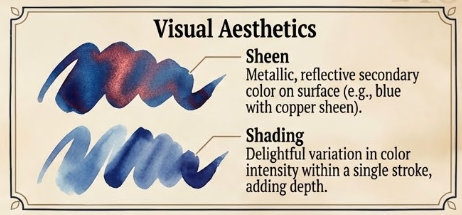
Sheen: Prepare to be amazed! Some inks, when they dry, leave behind a metallic, reflective secondary color that shimmers on the surface (e.g., a deep blue ink might "sheen" a coppery red). This is often best seen on high-quality, "sheen-friendly" paper.
Shading: This refers to the delightful variation in color intensity within a single stroke, creating lighter and darker areas where the ink pools. It adds depth and character to your writing.
Ghosting: When you can see the ink from the previous page showing through the back of the current page, without actually bleeding through.
Bleedthrough: The ultimate villain! When ink soaks completely through the paper, appearing on the other side as a dark spot.
Iron Gall Ink: A traditional, permanent ink known for its archival qualities, which often starts writing lighter and overtime oxidizes to a darker color.
Ink Crud (or Snot): Don't panic! If you see funky, crusty crystals growing on your nib—especially with orange or red inks—that’s just "ink crud." It looks like a science experiment gone wrong, but it’s harmless and washes right off with a bit of water.

The Nibmeister: The Pen Surgeon
Sometimes, no matter how much you "tweak" your writing angle, a pen just won't behave. Enter the Nibmeister. These are the skilled artisans and master technicians of the fountain pen world. Part engineer and part artist, a nibmeister can take a scratchy, grumpy pen and grind the metal until it writes like a dream. Whether you want to fix a Baby’s Bottom, smooth out some Tooth, or even have a standard nib custom-ground into a specialized shape (like a crisp Italic or a "stub"), the nibmeister is the person who makes the magic happen.

Beyond the Basics: Advanced Pen-Speak
You're getting there! Here are a few more terms that will solidify your status as an insider:
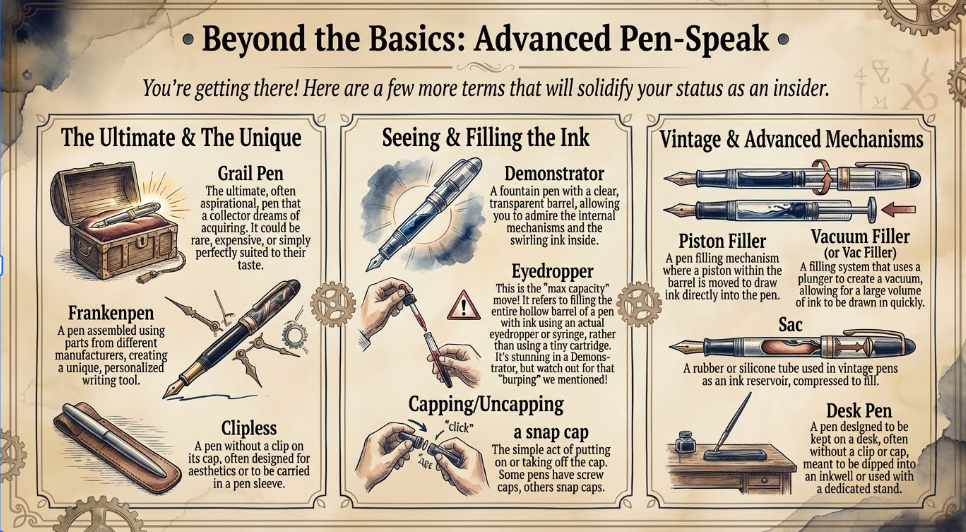
Grail Pen: The ultimate, often aspirational, pen that a collector dreams of acquiring. It could be rare, expensive, or simply perfectly suited to their taste.
Frankenpen: A pen assembled using parts from different manufacturers, creating a unique, personalized writing tool.
Demonstrator: A fountain pen with a clear, transparent barrel, allowing you to admire the internal mechanisms and the swirling ink inside.
Eyedropper: This is the "max capacity" move! It refers to filling the entire hollow barrel of a pen with ink using an actual eyedropper or syringe, rather than using a tiny cartridge. It's stunning in a Demonstrator, but watch out for that "burping" we mentioned!
Desk Pen: A pen designed to be kept on a desk, often without a clip or cap, meant to be dipped into an inkwell or used with a dedicated stand.
Clipless: A pen without a clip on its cap, often designed for aesthetics or to be carried in a pen sleeve.
Capping/Uncapping: The simple act of putting on or taking off the cap. Some pens have screw caps, others snap caps.
Sac: A rubber or silicone tube used in vintage pens as an ink reservoir, compressed to fill.
Piston Filler: A pen filling mechanism where a piston within the barrel is moved to draw ink directly into the pen.
Vacuum Filler (or Vac Filler): A filling system that uses a plunger to create a vacuum, allowing for a large volume of ink to be drawn in quickly.
Need More Visuals? Try our Slide Show:











Tell Us What Fountain Pen Terminology We Missed
Now that you've mastered this essential fountain pen terminology, the next time you hear someone lamenting a pen's baby's bottom or raving about an ink's incredible sheen, you'll be able to nod knowingly. The world of fountain pens is rich with history, engineering, and a vibrant community eager to share their passion.
When you hear a term that you don’t know! Contact us! We would love to help you find out what it means and add it to this list for everyone! ProvincialMills@Outlook.com


Comments